Munro Development and narrm ngarrgu Library and Family Services by Six Degrees Architects and Bates Smart
Often, mixed-use projects aren’t really that mixed – housing with some retail or commercial at the base. The redevelopment of the Munro site next to the famous Queen Victoria Market in Naarm/Melbourne is genuinely mixed-use, with some original heritage fabric retained. The project consists of private build -to-rent and social housing, a City of Melbourne library, family services, a hotel, retail, hospitality and car parking. Indeed, it started as part of a long-term masterplan to relocate the market’s car parking underground, freeing up the on-grade car park that sits atop Melbourne’s first cemetery. In this way, the project is an enabling work for the wider redevelopment of the Munro site, recently announced. The new proposal for the market site is one of extreme contrast – green public space on the old cemetery and a thin but tall wall of new buildings (designed by various leading firms) along the southern edge.

The City of Melbourne acquired the prominent site, previously owned by the Munro family, so that it could control activities and allow the wider masterplan to proceed. (The original Munro buildings included a pub, a collection of vacant warehouses and a series of quiet, north-facing shops along Therry Street.) The project is both urban design and architecture: a series of lanes and arcades cross the large site, forming new connections, and providing circulation and retail frontage deep into the site. A developer consortia model was used; the winning bidder was PDG Corporation. Architects Bates Smart (founded by Joseph Reed in 1853 in Melbourne) and Six Degrees (the firm that reinvented lanes and bars in the recovering city of the nineties) were engaged – this very “Melbourne” design team was selected for its connection to the city of which this project becomes a part.
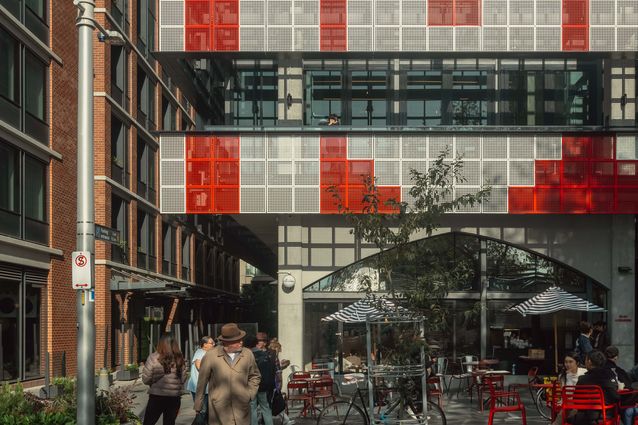
A masterplan for the site was developed by the design team and the City of Melbourne. Bates Smart designed the tall build- to-rent tower with its podium, the hotel, and the car park beneath the whole site. (The firm was also responsible for the interior design of the build-to-rent portion of the project; the hotel and retail interiors were done by others.) Six Degrees handled the other podium, with library and community assets, and the social housing above. Two significant artist commissions are prominent in the project: carpet, mirror and sculpture works by Maree Clarke and her team; and the large, very visible graphic text work in red and white, Screen Works (ENOUGH-NOW/EVEN/MORE-SO), by Rose Nolan. The landscape architecture, which plays out mainly on the terrific library terrace, is by Bush Projects.
Seen from the open urban spaces of the north and west, Nolan’s words – made from different-coloured 600-by-600 perforated panels – are large and legible. Comprising 1,600 square metres of screening, they form one of the largest artworks in the country. Shading the facade behind, the screen is both artwork and environmental device. Big text on buildings has a long and rich tradition, as both signage and public signifier. In Australia, it’s had a few runs – including Frederick Romberg’s ETA Factory on the old Ballarat Road and ARM’s Marian Cultural Centre in suburban Adelaide. But this might be the first time it has been so prominent in the middle of a city. And in this project, the big words are the work of a commissioned artist rather than the architect. The supertext is juxtaposed with the carefully considered brick, glass and steel language of the rest of the project.
Other text – words that have adorned the facade for decades – is also evident at Munro: MUNRO’S CORNER, and the name of the former pub, THE MERCAT CROSS HOTEL. New signage elements have been added – for the library and the hotel, and for the new food and beverage outlets. The net effect is an overlay of text of different fonts and sizes cast across the urban landscape. In this way, it represents the broader city; we read the city as well as see it.

On the upper levels of the building, the narrm ngarrgu Library is configured quite differently to a traditional library. It starts informally on the first floor, accessed by a large stair at the end of one of the arcades. It’s an entry that gets discovered rather than announcing itself in an obvious way on the main street – more like the City Library in Melbourne’s Flinders Lane than the State Library Victoria, a few hundred metres away.
On the first floor, you arrive in the bagungga reading room and event space – tall and long with light filtered through the screening outside. A deliberate gesture that draws from Donovan Hill’s wonderful Queensland Terrace at the State Library of Queensland, this elevated urban room is flexible enough for different uses. Here, too, it makes the most of its outlook and height. Retractable seating along the southern side allows for performances and talks; to the north, a large expanse of glass brings in winter sun and allows views across the market halls beyond.
The material palette through the library interior is diverse. The concrete structure and services are exposed but plenty of timber and painted steel is layered, and there are moments of bright colour, particularly in staircases, and some glam goldish finishes to the library counter and lift car interior. This rich blend of materials, served in a didactic way, clearly demonstrates Six Degrees’ years of experience in designing hospitality spaces.

The building’s social housing component – comprising 48 affordable dwellings designed to support individuals with varying support needs, plus six specialist disability apartments – sits on top of the public programs. Also expressing its concrete structure, it provides deep recesses for sun-shading and balconies. The private residential and hotel-focused part of the project, by Bates Smart, is cast in two more distinct parts – a clear podium and a tower. The podium is brick and articulated into a disciplined series of bays with glass and steel infills. The hotel sits within the podium above ground-floor retail; lobbies further activate Therry Street’s expanded footpath, which has returned to life with the opening of the project.
Highly visible within the broader context, the tower sits in sharp contrast to other recent residential towers in this part of the city. This is a result of both its form – two (stretched) cylinders that seemingly merge into one another – and also the air space surrounding it. The tower has some breathing room. The challenge with a form-led tower is planning out good-amenity apartments within. Here, the internal planning does better than others, drawing light deepish into the plan through cuts in the apparently continuous form. Balconies are well-handled, sitting within continuous spandrel bands, and are large enough to accommodate a table. The highly rounded form of the tower helps reduce the effects of wind on the street.
The Mercat Cross Hotel was a well-known pub with various subtenants over the years. It was important to the design team that a pub returned to the corner – a new bar/restaurant sits within the retained facade. The demands of the large new basement for car parking resulted in the facade alone remaining. While this is not an ideal outcome from either a heritage or a sustainability point of view, the team argues that heritage value can sit also with use. In addition, bricks from the former building have been reused in the new tower element located next to the original corner building. Careful detailing of these old bricks takes the eye up. A substantial roof garden, with trees, is situated above the old pub, providing outdoor public space and a children’s play area. A black steel fascia with expressed fixings seemingly bridges the old corner building to create this new elevated ground. This black industrial belt spans new and old, suppresses the car park entry and resolves the new taller corner.

— Stuart Harrison is an architect, a specialist in the reuse of buildings, and a director of Harrison and White. He is a senior lecturer in architectural design at the University of Melbourne.
link